Tuesday, February 14, 2012


        ”The spirit level” made a big (and persuasive, though debatable) point of some well known effects: people tend to care about how they turn out in comparison with others. People tend to compare themselves to people who are better off than themselves. In some interesting cases, people tend to care more about their relative than their absolute level of income, for instance.

        Status seems to matter. Almost every publication that talks about this topic has a background section about the importance of status relations in the evolution of social animals. Ape’s are brought to the witness stand. De Waal is mentioned. One reason such a section is included is to make a point about the irrepressible presence of this factor in our lives. However we are to cope with the effects of status differences, the anxieties, hostilities and pointless loss of well-being it entails, we cannot get around it: it’s a brute, evolutionary fact. If people are made unhappy by inequality, then we should diminish inequality. Not only in terms of wealth, but in every regard that matters.

        But the curious thing is that not everybody cares about status, whether in terms of attractiveness, wealth, knowledge or popularity. Some who are comparably less well off, and aware of this fact, are not bothered by it. Surely, though there are plenty of reasons to believe that diminishing inequality is usually the right thing to do, getting people to care less about inequality when it comes to things that doesn’t really matter should be part of the overall strategy as well. In related news, the detrimental effects of physical ideals derived from advertising and the like may be countered either by influencing their content, or by undermining their ideal-setting status.

        One route goes via switching comparison classes: compare yourself to a group in which you come out better.

        Another is by switching what is compared: some people have ”more money than taste”, for instance, so you could just switch the comparison that matters from money to taste and in the latter case, you come out on top. The great thing with this particular strategy is that taste is a matter of taste: two people can believe that they come out better in the comparison, and both feel better about themselves. Psychologists will often advise you to have a ”complex sense of self”, because if you have a number of personal characteristics that you care about, failure in one department doesn’t matter that much. In every group you find yourself, you are probably best in some regard, and you can choose to concentrate on that. Others may do the same, and no group has to decide which regard that matters in that group.

        But the preferable strategy, it would seem, is often not to care about the outcome of comparisons at all. It doesn’t matter all that much who’s got the better car, or even the better sense, because feeling good about oneself isn’t necessarily a matter of comparison. You may be contented without being smug, even over the fact that you have cracked this particular code. Sure, we usually do compare in order to evaluate, but we don’t have to do this. We may ”satisfice”, pick an alternativ that is good enough, as well as ”maximize” as an overall strategy. Not just when it comes to particular products but as a general life strategy as well.

        If wellbeing is to a significant degree and for most people dependent on coming out on top in comparisons, we should choose the kind of currency for comparison that makes the worst off less worse off. The great thing with money is also the problem with it: it buys stuff. If I have a lot of it and you got less I can buy the things that you need, and there is not much you can do about it. If I care for knowledge instead, for instance, and know more than you do, there is not less knowledge for you to get your hands on. The scarcity of job-opportunities aside, it’s hard to see why I should feel bad over the fact that you know more about philosophy and cognitive science than I do. And it’s certainly hard to see that the problem of academic jealousy should best be solved by making the ”top earners” know less, rather than by getting rid of this obsession.

        The case for inequality is often based on the premise that we need something to aspire to in order to be motivated. If we can become better off by developing some talent or working harder, we just might do that. Surely, that kind of psychological mechanism exists, even though it isn’t the only game in town. The thing aspired to doesn’t have to be money, and the process does not need to be a zero-sum game.

        Certainly, we need to take the problems of inequality and the tendencies mentioned seriously, as factual problems. But we shouldn’t take the psychological tendencies that constitute one of the conditions for these problems as brute, unchangeable facts.

        Everybody loves to get behind the hot young startup and embrace it as if it's the greatest thing in the world since sliced bread. Google+ is the latest examples with people in the know shouting and screaming from the rooftops about how amazing they are. When you see something special for the first time you just get that feeling in your stomach that you are in at the ground level and you are bursting with excitement waiting for the rest of the world to find out.

        People used to have that same feeling with Twitter and before that with Facebook. For a couple of years the online geeky community (I don't say geeky in a negative way because I was one) knew about Twitter, understood it's power and every piece of news coverage or mainstream attention was cheered as if we all owned shares in the company. Facebook was exclusive at the start too. Only my young cool "in-the-know" friends were on it for a couple of years. Most people looked at us talking about Facebook as if we had two heads and presumed it was some passing trend for kids. We've hit a very different situation now where Facebook and Twitter have hit the mainstream and for the first time in my recollection the press is starting to turn a little on them both...

        The problem here for Facebook and Twitter is that they are starting to become so ubiquitous that they are no longer exciting. I remember when mobile phones and SMS came on the scene it was the greatest thing we had ever seen at the time and there was endless buzz. We take SMS for granted now and there is nothing sexy about it and that is where Facebook and Twitter are headed. With revenues of over 2 billion and closing in on a billion users Facebook is no longer a startup and also no longer an underdog. A couple of years ago, it could have gone the same way as a Myspace or a Friendster but it's everywhere now. If anything, Facebook is the new Google, not in terms of what it does, but in terms of a company that has transitioned from startup to big tech giant that makes lots of money. Twitter still has a slight tag of underdog about it but it is also too important as a communication tool to just fade away. Just look at the way that Apple is baking Twitter in to every single one of their mobile devices. Sure people will start to use it in a different way and it will evolve but it is certainly here to stay.

        If Twitter is the place for cool kids now, what will happen if Twitter also starts to be used by everyone? Everyone migrate to Dr.Book (The new social networking by Dr.Rozmey)? I don’t think so.


Jews — the grandest of all hypocrites — systematically deny their holocaust against the Palestinians whilst demanding that individuals who dispute the official™ Jewish holocaust narrative be thrown in prison…

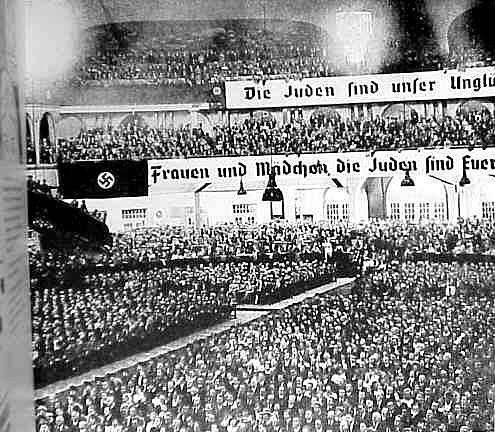
Hitler played heavily on the anti-Semitism already rooted within his people. He resurrected ideas that a previous king of Germany, Frederick the Great, had introduced. There were distinct categories of human beings. Essentially, the Germans were Aryans, and everyone else was sub-human. Hitler took these ideas and embellished them. He blamed the Jews for "two great wounds upon humanity: "Circumcision of the Body and Conscience of the Soul."

The Jews were accountable for that.

As Hitler gained popularity, his hatred of Jews spread and became a rallying cry.

The Nazi propaganda paper, Der Sturmer, revived the "Blood Libels." The church would warn their constituents: "Watch your children 6-7 weeks before Passover… Everyone knows that just before Passover Jews need the blood of a Christian child, maybe, to mix in with their Matzah."

The attitude taught to the children was, "Just as one poisonous mushroom can poison a whole family, one Jew can poison a whole town or a whole country!"

For centuries people are so bothered by the way we’re treating the Jews. They can’t understand it, because they are God’s creatures. But cockroaches and mosquitoes are also God’s creatures, and we destroy them.
Words can create an attitude. If a person says something loud enough and often enough, he creates a climate. And under that climate, all sorts of things can happen.

Sunday, February 12, 2012

The wise and the fools, the king and the wizard, and the thinker and the imaginator.  This is some of the excerpt that can be found from the article of Thinking Folly by the author of “The Power of Now” by Eckhart Tolle. The article contains one of the most unimaginable ideas that no common human can think of in this few decade. What Eckhart has interpreted in his article is that thinking is not the whole point of obtaining the Eureka moment, but the imagination itself.

In our daily life, we think to solve things. But as I see it, thinking isolates a situation or event and calls it good or bad, as if it had a separate existence. As too much reliance put upon thinking, reality becomes patchy.

In Tolle’s work, he describe thinking is a disease. The disease as he proclaim is where the mind of a human is the one that control you more than you control the mind. As he puts it, "the mind is a superb mechanism when it is used rightly. If used in the wrong manner, however, it becomes very destructive. This is what Tolle express in his article yet what he express does share the same belief as I am as I believe if one’s too dependent on it’s mind to think, then you yourself will be the puppet of your mind in the end of the day.

According to Einstein, thinking “plays only a subordinate part in the brief, decisive phase of the creative act itself”. Such quotation explains that those that who never stops to think is an idiot who didn’t want to accept what’s in front of them and what’s behind the big block that was created from the black fragmentation of wasted time. If you were to become a unique scientist or thinker, stop thinking and start imagining. If you didn’t, then your life is as common as the other human that live near you.

This is illustrated in a story of a wise man who have believe that he acquire a high degree of language skill in his life.

He enter a school that focus on that certain language and he and his family were very buoyant that he would gain a prestigious rank in the school.

But as time flies, he failed to achieve what’s being targeted and shall the people around him questioning the reason for his failure.

“What terrible wind that disrupts your study? Or perhaps you’re just being unlucky” they said.

The man portrays a sad face and said “Maybe”.

As silence comes in the conversation, the man leaves the school and began to study somewhere else.

When the next examination arrives, he shows a confident face that radiates all the other candidate about the success that might comes in this exam.

But again the tragedy repeats as for the outcome result isn’t amusing to his eye. Unfortunately, as friend of his accidently caught his gloomy face and unintentionally began to say a sad full question of “Are you and idiot, you could have done better.”

He answers “Maybe”.
The significant of the wise man to say “maybe” is to refuse of judging anything that happens.

But instead, he accepts in what just happen and believe there’s always an opportunity and opportunity isn’t being god or whatsoever, but it is us that who are suppose to create it.

If he were to try to think of his failure and find the reason for it, even thou with continuous failure attempt, he know there is a greater thing to worry and thinking of a failure for a written based paper examination would only trap you in your mind prison.

(P/S: Somehow i believe that my example of story doesn't seem to be "right". A reconstruct of idea will be made later on)


Friday, February 10, 2012

Critical Literacy(CL), a new word that i began to know little by little the meaning of it starting this 2012 semester.

Rumors from my seniors that this subject shall be a tough one do crack my heart of achieving 4 flat this sem, but literally when i enter CL class lectured by Mr. Mark, my notion changed into the positive side.

He taught us that CL is all about thinking deeply, logically, emphatically. It said that those who that master CL might do a major transformation in his/her life to a more unique one. So i said, why wait? The introduction itself merely resemble my cracked heart into a much more pleasant shape. I felt complete when i hear about the outcome of the study. It's just indescribably.

From a trembling soul that fear the new mythical like subject, now i'm more energetic to learn the subject deeper for my own benefit. I assume the subject itself is a challenge for me to a better man that can serve the community by providing solutions and such by thinking critically.


As the introduction being protracted, i shall assume Critical Literacy is a new adventure for me to experience and it's my duty to grab the chance to learn it perfectly.